EN
 English
 русский
 Español
 عربى
A 400-piece order of 180 x 130 cm cotton tablecloths leaves the factory at exactly 180 cm. Three commercial launderings later, the same cloths measure 174 cm, the corners no longer hang level, and the buyer who approved the sample is paying for replacements. A three to six percent gap does not appear at the table. It is decided at the cutting table, long before the first cloth is folded.
So here is the short answer: when you compare table cloth manufacturers, judge them on five things - who controls the greige fabric, which finishing lines they run in-house, how tightly they hold cut-and-sew tolerances, what test data they can put in your hands, and how they pack and ship. Price comes last, because a tablecloth that shrinks out of spec is the most expensive option on the quotation sheet.
What a table cloth manufacturer actually controls
Many companies sell tablecloths. Far fewer own the steps that decide whether the product survives a year of restaurant service. A factory worth auditing will give a straight answer on all five stages below.
- Fabric: woven in-house or bought against a locked specification, with lot-to-lot control on color, width and weight per square meter.
- Finishing: dyeing, printing, soil-release, softening, calendering or flame-retardant treatment - the stages that determine how the cloth behaves after washing.
- Cut and sew: pattern making, shrinkage allowance, mitered corners and hem construction.
- Quality control: dimensional and colorfastness testing on the actual production lot, plus an AQL inspection before packing.
- Export: labeling, carton specs, pallets and documents that survive the trip to your warehouse.
If a supplier can only talk convincingly about the last two, you are dealing with a trading company rather than a factory, and the risk on shrinkage and color moves to your side of the table.
Fabric choice drives almost everything
Complaints about tablecloths are rarely about the weave itself. They are about hand feel, staining, and how the cloth moves after laundering - and all three trace back to fiber content and fabric weight. The table below lists the fabrics most often specified in hospitality and retail programs, with the numbers worth asking for.
| Fabric | Hand feel | Stain release | Shrinkage after 5 washes | Typical use | Relative cost |
|---|---|---|---|---|---|
| 100% cotton percale or sateen | Matte to soft sheen | Moderate; improves with finish | 3-5% | Restaurants, banquets | Medium |
| Poly-cotton 65/35 | Crisp, slightly dry | Good with soil-release finish | 1-2% | High-turnover dining | Low |
| Stonewashed linen | Textured, relaxed | Low; natural marks show | 4-6% on first wash | Boutique hotels, retail | High |
| Jacquard polyester damask | Firm, lustrous | Very good | 1-2% | Banquet halls and events | Medium |
| Vinyl or PEVA laminated | Wipe-clean surface | Excellent, no laundering | Under 1% | Patios, cafes, outdoor | Low |
Two columns deserve more attention than they usually get. Shrinkage is a fiber property first and a finishing result second, which is why cotton and linen need the allowance built into the cutting pattern instead of a promise made at the sales stage. Stain release, meanwhile, is a finish: it can be specified, tested to a standard, and gradually lost after repeated industrial washing if the chemistry is cheap.
Fabric weight, in one picture
Weight is the quickest proxy for how a tablecloth drapes and how long it lasts. Lighter cloth costs less per piece but creases more and shows every fold line; heavier jacquards and laminated cloths hold their edges and photograph better for retail listings.
Freight follows weight too. Moving from a 160 g/m2 cotton to a 230 g/m2 jacquard adds roughly forty percent more fabric mass to every carton, which shows up in your landed cost even when the unit price looks similar.
Coated and laminated cloths solve the outdoor problem differently: a rectangular waterproof outdoor tablecloth wipes clean and skips the laundry loop entirely, which is why patio and holiday-rental programs often standardize on them.
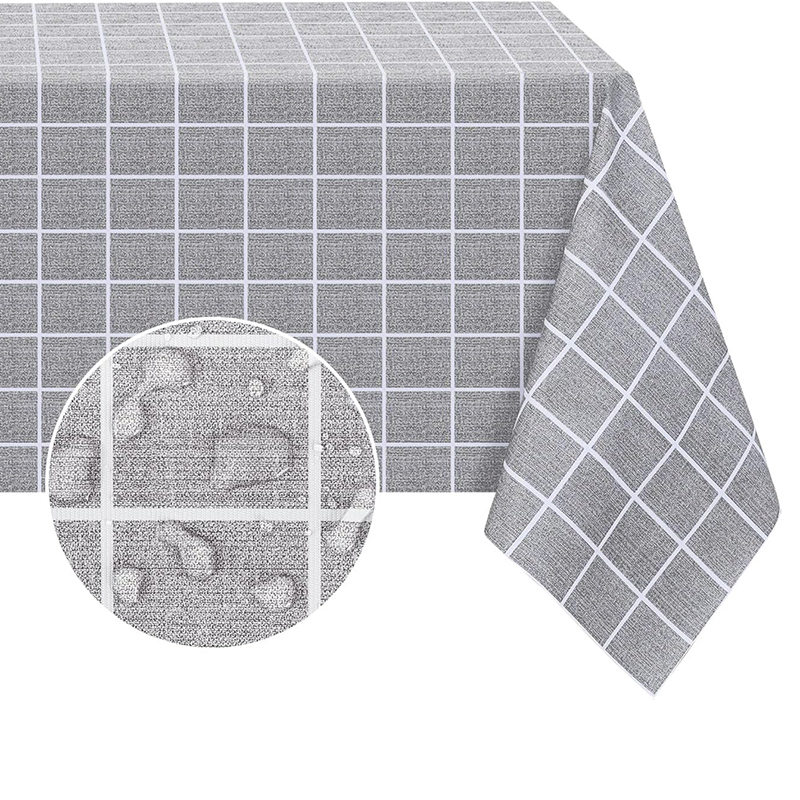 Rectangular Waterproof Outdoor Tablecloth for Events and RentalsA practical waterproof rectangular tablecloth that wipes clean, suited for outdoor events, patio use, and holiday rentals; available for wholesale.View Product →
Size, shape and hem tolerance: where most disputes start
Sizing arguments almost always come back to three specifications that were never written into the purchase order: finished size after laundering, size tolerance, and hem construction.
- Drop length: around 30 cm for banquets, 20 cm for restaurant service, 15 cm for casual dining, and 10 cm for buffets where guests stand and may catch a longer edge.
- Finished size: state post-wash dimensions rather than cut dimensions, and agree a tolerance. Plus or minus 1 cm on length and width is realistic for woven cotton; laminated cloths should hold tighter.
- Hem: 1.5 to 2.5 cm double-fold hems with mitered corners on rectangles, and an agreed stitch density so edges do not ripple after the first wash.
Round and oval cloths add a panel question, because a 250 cm diameter piece may need to be cut from more than one width. Confirm diameter, seam placement and panel count before the cutting ticket is issued. A simple round cotton dining room tablecloth in a solid color is a good reference item to compare against: one diameter, one seam decision, one hem, and the price difference between factories then comes down to fabric and tolerance rather than design.
 Round Cotton Dining Room Tablecloth in Solid ColorA simple round cotton tablecloth that serves as a useful reference for comparing fabric, seam, and hem decisions; suited for dining, gatherings, and wholesale inquiries.View Product →
Finishing, testing and the paperwork to request
Ask for reports, not assurances. For hospitality programs the useful documents are a dimensional stability test on the production lot, colorfastness to washing and to crocking at grade 4 or better, and - where your market requires it - flame-retardant certification to the standard your fire code references. Retail programs add fiber content, care label accuracy and any restricted-substance list the buyer's compliance team enforces.
Factory-level certification matters as an indirect signal. A plant holding ISO 9001:2015 for quality management and ISO 14001 for environmental management has documented process control in the same places an auditor would look: incoming fabric checks, cutting records, finishing recipes and final inspection. Certification is not a guarantee of good cloth, but its absence usually shows up as lot-to-lot variation in color and size, which is exactly the problem you cannot fix after shipment.
Sampling, order quantity and lead time
A tablecloth order should pass four gates before bulk: a lab dip or strike-off for color, a sample for construction and hand feel, a shrinkage test on that sample, and a sealed golden sample held by both sides. Skipping the third gate is the single most common reason a first order fails, because a sample that has not been washed tells you nothing about the dimensions your customer will actually use.
Quantities are negotiable within reason. Woven tablecloth programs commonly start at 500 to 1,000 pieces per color, lower on stock fabrics and higher on custom jacquards where loom setup has to be amortized. Lead time typically runs 25 to 40 days after sample approval for cotton and poly-cotton, and 45 days or more for printed or flame-retardant finishes. Suppliers who also run custom development alongside their catalog will normally explain their sampling steps in writing; the OEM and ODM programs behind the service page are a good example of how that workflow is usually described. A quote of 15 days on a custom print means the factory is either pulling stock or hoping you will accept a substitute.
How to vet a manufacturer before the bulk order
- Ask for the greige specification: fiber content, yarn count, weight per square meter and usable width. Vague answers here predict vague answers everywhere else.
- Request a production-lot shrinkage test rather than a marketing sheet with best-case numbers.
- Confirm which finishing stages are in-house and which are subcontracted, since subcontracted finishing is where color and hand feel drift.
- Verify certificate numbers and scope, not just the logos on the website.
- Agree the inspection standard - AQL 2.5 for major defects is common - and decide who pays for third-party inspection.
- Review packing details: polybag, insert card, pieces per carton and carton dimensions.
Fabric libraries are still easier to judge by hand than on a screen, which is why buyers who audit online also walk the aisles at events such as the Intertextile home textile exhibition to compare weights and finishes side by side.
Packing, freight and landed cost
Tablecloths are bulky but relatively light, so freight is decided by carton volume rather than weight. Two practical numbers: a 40-foot high-cube holds roughly 65 to 68 cubic meters, and a tightly folded cotton tablecloth compresses to about half the volume of the same item packed in an individual gift box. If retail packaging is required, ask for packed carton dimensions at the sampling stage and price the freight on those figures instead of on the product alone.
The remaining questions are mundane but decisive: FOB or CIF, which port, whether cartons are palletized, and whether the factory can hold finished goods until a consolidated shipment departs. A plant within a two-hour drive of a major port can usually re-plan a shipment in days rather than weeks, which is worth more than a small price advantage when a seasonal program is running late.
The tablecloth that arrives on spec is rarely the cheapest one quoted. It is the one whose fabric weight, shrinkage allowance, hem and finish were agreed in writing and then verified against a sealed sample. Choose a manufacturer who can walk you through those stages with documents in hand, and the size dispute at the linen room door stops being a recurring cost.